2. Retention & Transfer · Parametric earthquake insurance
Parametric earthquake cover · Andes
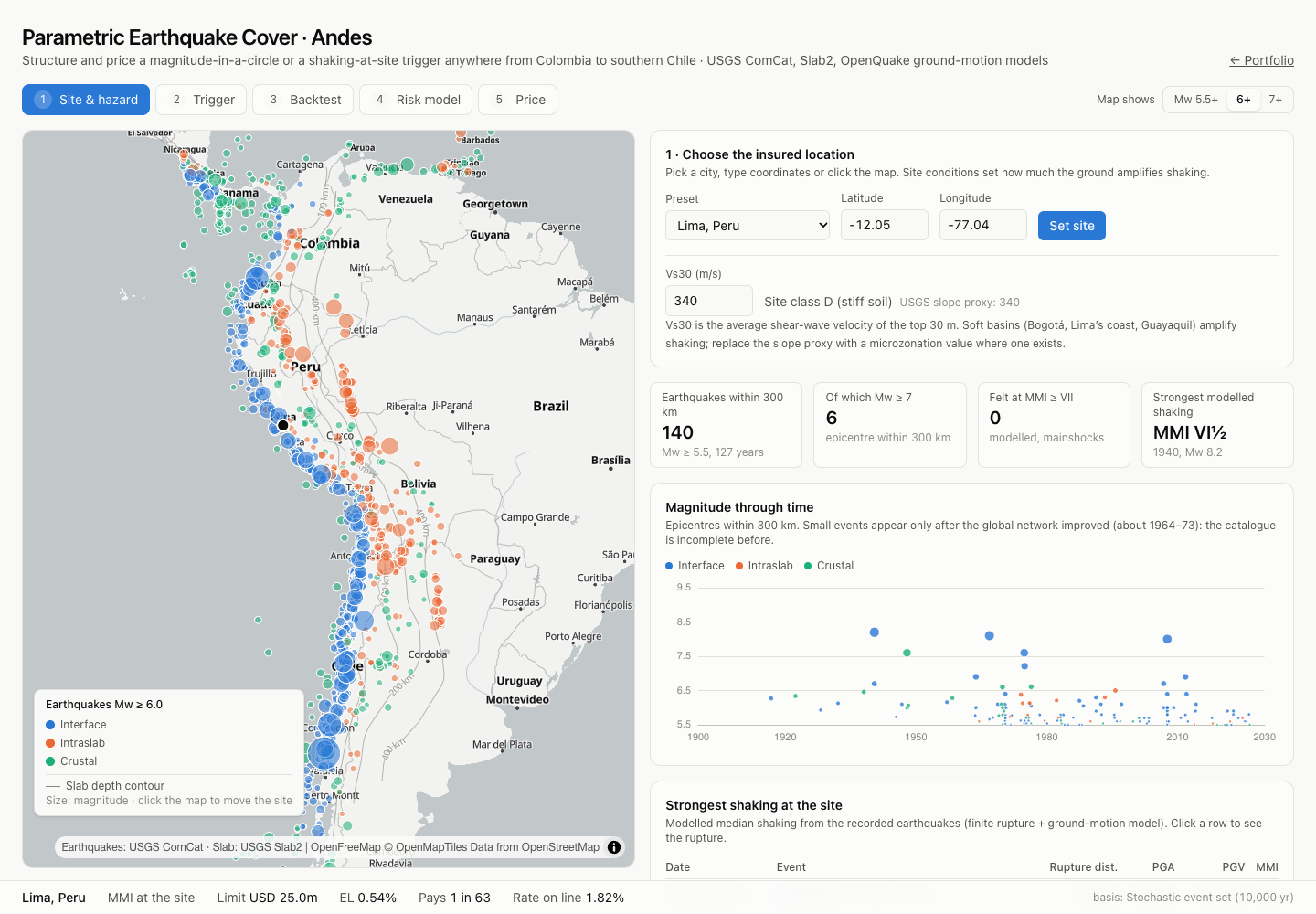
Helps a government, lender or insurer choose between a magnitude-in-a-circle and a shaking-at-the-site earthquake trigger for a city, see what each would have paid and price both on a 10,000-year event set.
The problem
Earthquake cover for public budgets in the Andes is mostly parametric, because it has to pay within days. The trigger choice drives everything. Magnitude in a circle is transparent, but blind to depth, rupture length and soil. Shaking at the site tracks damage better, but relies on a model both parties must accept.
Approach
- Catalogue: USGS ComCat since 1900, homogenised to moment magnitude, classified as interface, intraslab or crustal against the Slab2 slab, and declustered (Gardner–Knopoff).
- Recurrence: bilinear Gutenberg–Richter per class (Weichert maximum likelihood with magnitude-dependent completeness) and smoothed seismicity, simulated over 10,000 years.
- Finite ruptures sized by magnitude scaling; great megathrust ruptures follow the trench along the Slab2 contours.
- Ground motion from Parker et al. (2020) NGA-Sub (South America terms) and Boore et al. (2014), ported from OpenQuake hazardlib and tested against it. Shaking is computed as PGA, PGV and MMI (Worden et al., 2012) at the site’s Vs30.
- Two triggers side by side: burn analysis since 1900, event-by-event comparison of where they disagree (basis risk between designs), payout exceedance curves, and Wang-transform pricing with a term sheet.
Result
An interactive five-step tool that runs as a static site, documented step by step. It also checks the hazard model honestly against building codes and a published study for 21 cities.
Next steps
- A ground-motion logic tree, which would bring the Peru–Chile coast down to the published hazard levels.
- Exposure-weighted city indices, and observed ShakeMaps for the backtest.
- Loss-based basis risk.
Limitations
Illustrative portfolio exercise on open data only, not an offer of insurance. Smoothed seismicity rather than fault sources; loadings are not market quotes.
- Tools
- OpenQuake hazardlib · Python / xarray · React · TypeScript · MapLibre · ECharts
- Open data
- USGS ComCat · Slab2 · USGS Vs30 · NGA-Sub and NGA-West2 ground-motion models