2. Retention & Transfer · Sovereign disaster risk layering
Sovereign risk layering · Madagascar
Helps a ministry of finance decide how much to hold in reserves, how much contingent credit to arrange, which layers to insure and what to leave to post-disaster borrowing, at the lowest economic cost.
The problem
Madagascar is hit by cyclones, floods and droughts, and the government pays a large part of the bill. It can pre-arrange money (reserves, contingent credit, insurance) or find it after the event (budget cuts, new borrowing). Each instrument has a different cost and speed, and the cheapest mix depends on how often and how badly each layer of loss is hit.
Approach
- Loss profile. Assumed event loss tables for cyclone, flood and drought, anchored to public benchmarks (GFDRR country profile, Enawo, Freddy, the 2021 Grand Sud drought) and simulated into a 10,000-year year loss table. A catastrophe model’s ELT can replace them.
- Framework. The opportunity-cost model of Clarke, Mahul, Poulter & Teh (2016, World Bank PRWP 7721): a fixed and a per-dollar-used cost for each of five instruments, funded cheapest-first. The implementation reproduces the paper’s own worked example.
- Optimisation. Reserve size, contingent credit and an insurance layer per peril are chosen to minimise expected cost. An option weights the cost of a bad year to reflect aversion to budget volatility.
- Sensitivity. Each assumption is moved in turn and the optimum re-computed.
Result
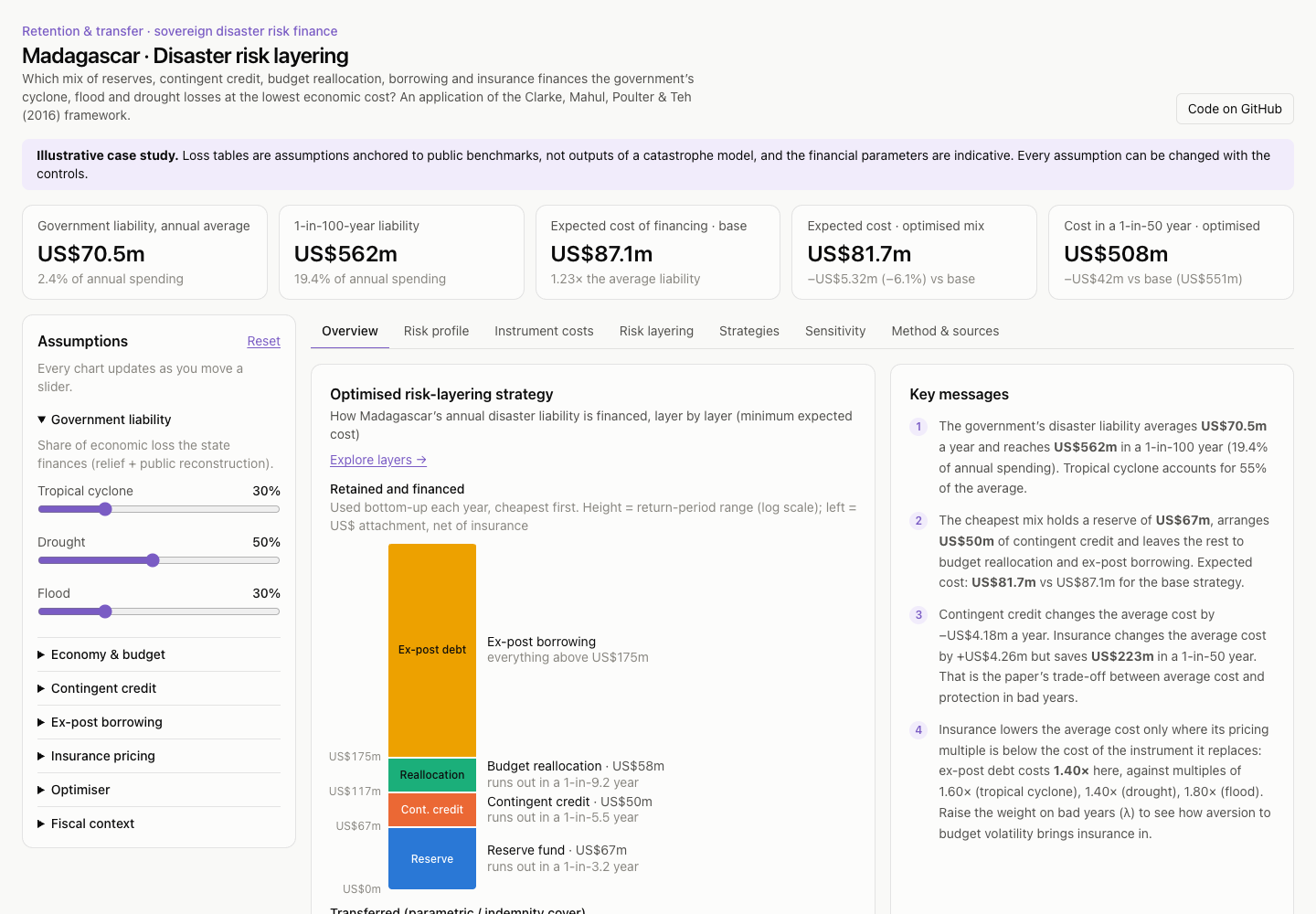
An interactive dashboard with the loss profile, marginal cost multiples, the optimised layer tower, a comparison of strategies (base, + credit, + insurance, both, optimised, your own) and a tornado chart. Everything recomputes in the browser as the assumptions change.
Companion study
The transferred layer is designed in detail in the parametric cyclone cover case study: trigger, payout history and pricing.
Limitations
Illustrative. The loss tables are assumptions, not modelled. Insurance is priced with a flat multiple and pays exactly its layer (no basis risk). Not financial advice and not an official assessment.
- Tools
- Python / NumPy · TypeScript · React · ECharts · Web Workers
- Open data
- Assumed ELTs anchored to GFDRR · World Bank and OCHA figures · IMF fiscal data